Slow Oven BBQ Ribs with Spicy Broccoli-Potato Salad

Barbeque ribs made in my kitchen oven on a cold, cold day made it seem like…well, somewhat nearer to summer, let’s say!

 In the middle of of the winter, I become entranced with the idea of summer food.  I crave hamburgers on the grill eaten outside at the picnic table.  I adore the idea of Sangria and a big crab salad.  (I have the opposite reaction when in mid-July I crave beef stew. Every year.)

Maybe it’s just vacation that draws me.

But I really think it’s the food.

So I make a summer meal the best way I can.  I throw a checked tablecloth on the dining room table, put the beer mugs in the freezer, and make something we typically only eat in the summertime.  Like ribs.  Just in time for Super Bowl or any other cold February day.  Brrr.

 Here’s how… in (mostly) chronological order with photos:

… … ... … … … …

               Cook’s note:  These ribs cook for three hours. You’ll make the broccoli-potato salad during the last forty minutes (or earlier, if you’d like).

slow oven barbeque ribs and spicy broccoli-potato salad
makes 1 rack of ribs and plenty of potato salad for 4-6

Disclaimer!  These “recipe” ingredients (with the exception of the bbq sauce and the mustard vinaigrette) and the methods are pretty loose;  I did not document my process as I often do.  Use your best cooking sense and make this meal your own.  For instance, I do not measure rub ingredients; I mix a rub and smell it to see if it’s about how I’d like it.  (Click on “favorite rub” to find a rub you’d enjoy.)  And I don’t put brown sugar in my rubs, which most people do.  My brown sugar is in my sauce.  Do make  your own barbeque sauce…link provided below.   Or take a basic recipe from somewhere and make it your own.  Don’t buy sauce; it’s a ripoff.  You’ll love having it in the refrigerator for burgers or chicken.  Have fun!

 Preheat oven to 300 degrees    Dry ribs with a paper towel and rub both sides well with your favorite rub.

  • I like approximately 2 teaspoons each kosher salt, fresh ground black pepper, rosemary, and dehydrated onion and garlic.  I then add 1/4 teaspoon each ground cayenne and cinnamon.  Mix this all together in a small bowl before rubbing on ribs.  (Enough for one rack of ribs–or make more to your taste.)  Some cooks apply this rub the night before, storing rubbed ribs in the refrigerator.  I do it right before I cook them.

Place rubbed ribs on a foil-lined sheet pan and let roast 2 1/2 hours, turning over once midway through cooking time.  In the meantime, make your own barbeque sauce.  (Scroll down for my “recipe.”)

About 40 minutes (or more),  before the ribs are done, start the potato salad:  Place 10-12 red potatoes in a heavy Dutch Oven with 2 tablespoons olive oil and 1/2 teaspoon kosher salt along with 1/4 teaspoon black pepper.   Heat pan over medium-high flame and cover tightly. Reduce heat to medium low.  Let cook twenty minutes or so, turning down heat if potatoes are browning too quickly or turning up if they’re not cooking.   (If you’d like a boiled egg in your potato salad, now’s the time to make one. Without the egg, the broccoli-potato salad is a hearty vegan dish.)

 Cut two larges heads of broccoli into florets and chop 2 tablespoons red onion (finely)  and 1/4 cup each  fresh parsley, red or yellow bell peppers, carrots, and celery.  Set aside all the vegetables except broccoli.

 Add broccoli to pot and cover for another ten minutes or so or until both potatoes and broccoli are tender.  They may get crispy or browned–no matter.
 

In the meantime, check the oven:
 
After about 2 1/2 hours:  Remove ribs from oven and brush thickly with barbeque sauce. Return to oven.  Repeat every ten minutes 2-3 x until ribs are tender and browned (or until they’re cooked to your liking.) 

Back to the potatoes and broccoli:

 When broccoli and potatoes are tender, remove from pot, chop into 1-2-inches pieces and place potatoes in a large bowl.  Season lightly with salt and pepper, a pinch of crushed red pepper,  and drizzle well with Mustard-Tarragon Dressing while hot (see below for dressing recipe.) Stir well.  Add the broccoli along with reserved chopped fresh vegetables and a chopped boiled egg, if using.  (Skip egg for a vegan version.) Stir well, taste and adjust seasonings, adding more dressing as needed.  Serve warm or at room temperature with extra dressing at table.  (You can choose to add the broccoli along with the potatoes if you like; it’s simpler.  I like the vinaigrette to hit the hot potatoes.)

When both potato salad and ribs are done, cut ribs into two-rib portions and serve with warm or room-temperature broccoli-potato salad.  Enjoy!

Wine, if you’re not drinking beer for the game:  Any California zinfandel.

        ——-Recipes——–

 Barbeque Sauce

2 cups each ketchup and chili sauce
1/4 cup each lemon juice and red wine vinegar
1/2 cup water
2 tablespoons each yellow mustard, Worcestershire, A-1 Sauce
1 tablespoon Soy Sauce
2 cloves of garlic, finely minced
1/4 teaspoon fresh ground black pepper
4-5 Big swigs of Tabasco or other hot sauce
1/2 cup brown sugar
3 tablespoons celery seed

 Whisk together in a medium pot and bring to a boil over medium flame. Taste and adjust seasonings.  Lower heat to simmer and let cook 30 minutes.  Store leftovers in a tightly sealed jar for up to two weeks in the refrigerator.

 
Mustard-Tarragon Dressing

1 clove of garlic, crushed and minced or grated

1 1/2 tablespoons Dijon-style mustard

3T white wine vinegar (I like Chardonnay, but any will do.)

9T extra-virgin olive oil (the best you have for this salad)

1/2 t kosher salt and 1/4 t fresh ground pepper

2 drops hot sauce, such as Tabasco or more to taste

1T chopped fresh tarragon  or 1 t dried

In a large bowl, whisk together the garlic, mustard and vinegar. Slowly add olive oil, whisking all the time or after every addition. Season with salt, pepper, hot sauce and tarragon. Whisk until well-emulsified. Taste and adjust seasonings if necessary.   Store leftovers in a covered jar so you can shake the dressing right before each use.
… … … …

Sing a new song,
Alyce

38 Power Foods, Week 29 — Pecans — Light Winter Vegetable Gratin with Savory Granola

Each Friday, a wonderful group of women reaches across cyberspace and joins culinary hands to salute one very healthy food, one single beautiful ingredient from Power Foods : 150 Delicious Recipes with the 38 Healthiest Ingredients.  (Scroll down for the list of blogs.)

I won’t say it’s not a challenge to come up to that gorgeous plate each week.  If I’m busy learning music for church or have my daughter home, or am busy with the soup book, I sometimes can’t give the opportunity the intelligent focus and attention it deserves.  I used one great recipe for more than one blog recently….life can get ahead of me sometimes.  Hopefully I’m forgiven!

This week, the week of pecans, I had the time I needed to give this a good stab.  To give it my undivided creative space.  I’m grateful for the opportunity and the chance to move one sweet iota further in my cooking and writing.  I hope you’ll enjoy the idea of this light vegetable gratin…which is maybe a bit more like a terrine in character, though not in the size and shape of a terrine.  There’s no cream and no butter here unlike most gratins.  There is a crusty, crispy topping; it’s a savory oatmeal granola without butter (yes, it has olive oil) to which I’ve added the traditional gratin component of cheese, but also finely chopped pecans.

While pecans are an American nut staple grown in the southern states, they’re not terribly common in other parts of the world, with the exception of South America. High in protein (though lower than almonds and walnuts), they are also high in healthy unsaturated fat, a good source of fiber and vitamin E,  calorically dense, and weigh in at nearly two-hundred calories per one ounce serving. Store them in the freezer and use as needed.  They are excellent for baking, cooking, and for general snacking.

 LIVESTRONG NUTRITIONAL INFO FOR PECANS

Gluten-free and easily vegan (leave out the Parmesan), this winter vegetable gratin with healthful  pecans in its topping is not only a gorgeous side if you need or your partner really needs a chop… but is a lovely lunch or entree for those in love with vegetables. (You might add more pecans for protein for the vegan version.)  A sharp knife, a shallow dish (I used a heavy quiche pan in lieu of a gratin dish as I liked the shape, but even a 2 quart Pyrex would do), and a boatload of winter vegetables are the central components of your beautiful, filling meal.  Try this:


winter vegetable gratin with savory granola


vegetables:
  • 2 tablespoons olive oil, divided (needn’t be extra virgin)
  • 1/4 cup red onion, minced
  • 2 garlic cloves, minced
  • 1/4 cup fresh parsley, minced
  • 3 medium carrots, peeled and sliced thinly
  • Kosher salt and fresh ground black pepper
  • 3 stalks celery, trimmed, stringed, and sliced thinly
  • 2-3 parsnips, peeled, and sliced thinly
  • 1/2 fennel bulb, cored, and sliced thinly
  • 1 turnip, peeled and sliced thinly  
  • 1/2 cup vegetable broth                                       
  • 2 tablespoons white wine      
  • finely grated lemon rind, optional garnish (at table)       


granola: (in a medium bowl, mix together well:)
 

  • 1 cup old-fashioned oats
  • 1/4 teaspoon each:  kosher salt and fresh ground pepper
  • 1/8 (pinch) aleppo pepper (can sub crushed red pepper)
  • 2 tablespoons finely grated Parmesan cheese (omit for vegan version)
  • 1/4 cup pecans, chopped finely
  • 1/4 teaspoon dried thyme
  • 1/2 teaspoon dried rosemary, rubbed well in your hands or chopped finely
  • 1 tablespoon olive oil
  • 3 tablespoons vegetable broth   


  1. Preheat oven to 400 degrees Fahrenheit (205 Celsius).  In a small bowl, mix together red onion, garlic and parsley; set aside. With 1-2 teaspoons oil, brush the inside of a 9-10shallow casserole dish or gratin dish.
  2. Layer carrots, celery, parsnips, fennel, and turnips in dish, drizzling each layer with a little olive oil, salt/pepper, and sprinkling each layer with about 1 1/2 tablespoons of the onion mixture.  (Place the rest of fennel at center if possible.)  Mix the broth with the wine and pour over the vegetables.
  3. Top  with savory granola mixture* by crumbling it evenly over the vegetables. Cover tightly with aluminum foil. Bake 30 minutes. Remove foil and bake another 30 minutes until granola is crispy and vegetables are tender.
  4. Serve hot with a bit of finely grated lemon rind, if desired.  

*You may not need all of the granola; you can eat the rest as is for a good snack.
…  …  …  …
 If you liked this, you might like my Derby Pie–a Pecan-Chocolate-Bourbon specialty made only for the Kentucky Derby–May 3-4, 2013.

Or you might like my Go Nuts!  which can be made with all pecans or a mixture of  nuts:


… … … …

Here’s our wonderful group of bloggers.  Join us!

Minnie Gupta from TheLady8Home.com

Sarah – Everything in the Kitchen Sink

… … … …

P.S. If you linked my cinnamon rolls to your blog, I’d love to know who you are!  It’s now my top post in nearly five years.   I’d like to thank you….

Sing a new song,
Alyce

10 Pounds in 8 Weeks or Subtract 35,000 Calories: Week #2

One dinner from last week.  I love one-pan meals.  I’ll blog this on dinner place.

I have my black coffee in front of me.
I just ate my egg white-veggie omelet with salsa. YES!
The only change from a “regular” morning is no cream in my coffee.  Pretty painless, huh?

I did stay on the program ..  with a couple of deviations:


I don’t know if I lost any weight for sure as I just finally bought a scale and weighed myself this morning.  No, I’m not giving you that information.  I do feel a little smaller and my jeans are a bit more comfortable.  I did my exercise without complaint even, though a couple of days I probably cut out a few minutes earlier than I’d hoped to.  I am happy and hopeful and upfront.  So:

Exercise for the week…

I did the morning stretch routine every day, weight training 2x (so I missed one of those), and walk/dance 4x (I add a little more interest to this linked indoor 3 mile walk routine) while I watched Morning Joe or even Ina Garten late afternoon.  I found the late afternoon didn’t work for me at all. I was stiff and unhappy.  Mornings are best for Alyce.   If you’ve never tried an indoor walking routine, try Leslie Sansone (she has a variety of workouts on youtube) and see what you think.  It’s icy here; I’m better off indoors.  I do walk outdoors as weather permits, but really enjoy the variety of steps involved in an indoor routine.   The second link above (Leslie Sansone) is to a beginning walk.  You can work your way up to more difficult and more time-consuming programs or you can also cut back and use her 2-3 minute computer breaks, which I love.

Herb-Spinach Egg White Omelet

Food:

I kept a breakfast routine of egg white and vegetable omelets Monday-Friday, which is what I eat in the winter anyway.  Saturday, I made oatmeal with raisins, almonds, and milk.  Sunday I had a 1/2 cup plain yogurt and blueberries.    My lunches consisted of  fresh fruit or vegan vegetable soup (below)– which I blogged–for four days only.  The other lunches I had what I liked within reason:  a veggie burger with half a bun and cole slaw  or scrambled eggs (with yolk!) and vegetables with salad and a glass of white wine for Sunday brunch.

30-Minute Vegetable Soup a la Provence

If I became peckish in the mid-afternoons, I had a few nuts.  I always drink a mixture of green and mint teas in the afternoon, which I continued.  I increased my water intake.  Dinners were as always–not a lot of change–but cutting back on servings and being careful about fat content.  They varied from salmon (above) to chicken chili to skinny-crust anchovy pizza with salad.  Friday I made barbeque ribs and potato salad with vinaigrette for a mid-winter summer treat.

This week I plan to vary my lunches by taking time to create a large salad I can eat off of for a couple of days.  I’ll make another vegetable soup; we’ll see what’s in the frig!

I take a regular multi-vitamin and 1200 mg of calcium each day.

In case you missed last week, here’s what I’m doing:

My current fitness goals include these objectives:

  •  lose ten pounds in eight weeks by changing/cutting back on my food intake and to….
  •  put in 30 minutes of aerobic exercise 4 days a week (outdoors when possible)
  •  do a stretch routine daily
  •  weight train 3 times a week
  • blog my progress weekly

If you do the math, we’re talking about (how do I get) 10 pounds off by Saint Patrick’s Day (Sunday, March 17), which, if you’re a long-time reader, you know is when I have a houseful of potato soup and soda bread:

I have a total of 35,000 calories to get rid of by any means that works.  I can do the math.  I know what foods have what calories (I’m a food blogger and have cooked all my life!) and I know what calories are burned by my typical exercise routines.  If I wanted to buy a beautiful $35,000 car for cash, I’d have to bank the money monthly–right–until I had enough to walk in to the dealer and lay down my check. (I’m doing that actually–for a trip, not for a car.)  To lose weight, I use the same concept, but in reverse.  I START OUT WITH the 35,000 in my “bank” and I take some out each week until there’s nothing left.  If God is good (and I know that’s the case), I’ll have lost 10 pounds.
My way.  Still eating things I like within reason.  To make things rounded off and easy, I plan to take away, subtract, lose (whatever) 4,000 calories per week for a total of 32,000 calories.  The other 3,000 or 377  per week (53 per day) will come from less fat and dairy in my regular daily diet.

The weekly goal is to take away 4,000 calories per week for a total of 32,000 calories like this:

  1. 30 minutes of low aerobic exercise (walk/light dance w/ 2 min run) a day 4 days a week (400 cal.)
  2. No cream in my coffee 6x a week (Even God rested on Sunday.) (600 cal.)
  3. No meat -2 nights a week/Cut back a bit other nights (1,000 calories)
  4. Vegetables or fruit ONLY 4 lunches per week–the lion’s share (2,000 cal.)

    Sing a new song and thanks for your support,
    Alyce

    38 Power Foods, Week 28 — Almonds — Pear-Almond Crostata

    I had parents who were full of quirky sayings.  My dad, being from the south, often said, “If I could only eat one food on earth, I would choose peanuts.”  (If he’d been from Minnesota, he would have needed to say walnuts.) Another day he’d put milk or eggs in that exalted position, but it was always one of two or three favorites. In other words, if you had to go on a long hike or be out on the lake fishing for a long time, bring nuts.  You’d be happy-crunchy and, while he never mentioned it, you’d be full from the fiber and not be hungry for a long time given the protein and fat content of nuts.

    My kids once had a doctor who, beside being a wonderful human being and just as good of a doctor, invited us in to his office each visit.  He’d turn around and sit and chat a minute or two before getting down to business.  Once in a while, he’d say, “I haven’t had lunch yet; let me get something to eat while we visit.”  Out of his drawer would come a big bag of plain almonds.  He’d pour a handful or two out for himself and offer the bag to us.  “Best lunch available in a drawer,” was his line.  He’d chomp several before saying, “All right, I’m ok now; I was starved.”

    I’m sure neither of these men had pear-almond crostata in mind when he thought about nuts as an excellent source of nutrition, though I do!  It never hurts to add a little protein and fiber to a scrumptious dessert and, while I make lots of desserts (among other things!) with almonds in them– (I use almond paste as the bottom layer of my strudel) — this is my favorite.  Most of my friends have eaten a crostata or two at my house.   It’s a special occasion treat and I make it for birthdays, dinner parties, or holidays.

    If you’ve never made a crostata  before, don’t be frightened by the name; it’s just a free-form pie that every self-respecting home and professional cook in Italy makes regularly. (Italian crostatas are often made with jam rather than fresh fruit.)  I find it simpler and tastier than an American pie; it’s forgiving in shape, size, and texture; it’s perfectly luscious and has the oooooo and ahhhhhh factor desserts deserve.

                                       Recipe for a raspberry jam crostata here.

    The dough for my crostata is made in the food processor and is done in a flash.  Try this:

    pear-almond crostata

    4 regular or six small servings for one crostata

    Parchment paper needed for baking

    pastry:  (makes 2-freeze one for later)
    • 2 cups white, unbleached flour
    • 1/4 cup granulated sugar
    • 1/2 teaspoon kosher salt
    • 1/2-pound (2 sticks) very cold, unsalted butter, cut into pieces
    • 1/4 cup ice water

    In the food processor, fitted with the knife blade, pulse together the flour, sugar and salt.  Add the cold butter and pulse until mixture is the size of peas.  Slowly add iced water through the feed tube until dough begins to come together.  Remove carefully from processor and divide in half.  Press each into a disc.  Wrap one in foil and freeze it.  Refrigerate the other for an hour is best, but you can roll it right away if you must.  Dust the counter very well indeed with flour and roll the disc, using a rolling pin, into an 11″ circle.  Place on parchment lined baking sheet until you have the fruit ready.  (Check out the pics here where I give you two options for getting the pastry from the counter to the pans.)  You can  a. fold it up gently and  quick like a bunny pick it up, and centering it over the baking sheet, place it carefully down and unfold it or, b. loosely roll the dough back onto the rolling pin and move the rolling pin over above the baking sheet, lowering it and loosening the pastry down flat onto the pan.   

    The pastry recipe for this comes from Ina Garten, who, I might have gotten(?) it from  Joanne Killeen and George Germon in CUCINA SIMPATICA; ROBUST TRATTORIA COOKING.  

    filling:

    • 1-1 1/4# pears (Seckel or Bosc or a mixture), peeled, cored and cut into 1″ chunks
      (Pears should be ripe or nearly ripe and still firm)
    • 1-2t grated lemon rind
    • 1/4 c sliced almonds
    • 1/4 c ea flour and sugar
    • 1/4 t kosher salt
    • 1/4 t cinnamon
    • 4T unsalted butter

    Preheat oven to 450 and place rack at center.

    In a large bowl, mix cut-up pears with lemon rind and most of the almonds, reserving 1T or so for the top of the crostata.  In the food processor, make a crumb topping for the crostata by pulsing together the flour, sugar, salt, cinnamon and butter until crumbly.  Remove the blade from the processor bowl, and, using fingers, pinch together the crumbs until they hold together

    Place pear-lemon mixture onto the pastry, leaving 1 1/2 inches around the edges.  Crumble topping on the pears evenly and sprinkle with the last of the almonds.  Fold the edges of the pastry up and over the fruit, gently pleating the dough at the corners.  You’ll be leaving most of the fruit covered by only the crumbly topping; the pastry just comes up around the edges of this pie.

    Place baking sheet in oven and bake 25-30 minutes (use the longer time above 5,000 feet) until golden brown and crispy.  Remove from oven and let sit for 5 minutes before sliding pie off the paper onto wire rack to cool completely.  Will hold at room temperature a day or so and in the refrigerator for several days, though it is best fresh.

    Note:  If you’d like to make an apple crostata with the other crust, it’s made almost like the above pie, but you’ll need 1 1/2 # (3-4 large Granny Smith) apples, 1 t orange peel and no nuts unless you choose to add some one your own.  If you do, toasted walnuts might be best.

    {printable recipe}

    The best drink for crostata is a cup of fresh black coffee.

    ALMONDS…

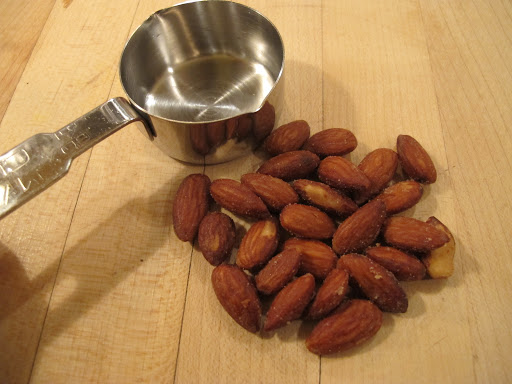
    This is a one ounce serving of almonds–about 25 and almost 1/4 cup.


     Almonds are an excellent source of vitamin E, magnesium, and manganese; they are a good source fiber, copper, phosphorous and riboflavin. When compared ounce for ounce, almonds are the nut highest in protein (6g), fiber, calcium (75mg), vitamin E, riboflavin and niacin (1mg). Talk about good things coming in a small package. 

    The average woman needs 46 grams of protein per day. She needs 25 grams of fiber.  (webmd.com)

    .

      Nutrient Content of Tree Nuts–Almond info in RED.

    USDA Nutrient Laboratory Database, Release 20 (Nd – no data); Bolded numbers indicate highest value.

    (1 ounce whole natural) Almond Brazil Nut Cashew Hazelnut Macadamia Pecan Pistachio Walnut
    Calories 163 186 157 178 204 196 158 185
    Protein (g) 6 4 5 4 2 3 6 4
    Total Fat (g) 14 19 13 17 21 20 13 19
    Carbohydrate (g) 6 4 9 5 4 4 8 4
    Dietary Fiber (g) 3.5 2.1 0.9 2.7 2.4 2.7 2.9 1.9
    Calcium (mg) 75 45 10 32 24 20 30 28
    Iron (mg) 1.1 0.7 1.9 1.3 1.1 0.7 1.2 0.8
    Magnesium (mg) 76 107 83 46 37 34 34 45
    Phosphorus (mg) 137 206 168 82 53 79 139 98
    Potassium (mg) 200 187 187 193 104 116 291 125

    NUTRITIONAL INFORMATION COURTESY bluediamond.com

     
     Our blogging group:

    I blog with a great group of writers every Friday where we cook our way through the list of foods from Whole Living Magazine’s Power Foods:  150 Delicious Recipes with the 38 Healthiest Ingredients:    Read more  at these sites today or sometime in the future (Not everyone posts this week.): 

    Minnie Gupta from TheLady8Home.com

    Sarah – Everything in the Kitchen Sink

     Are you a food blogger?

      This Week on More Time at the Table–Warming Dinners:

    Vegetable Soup (Vegan and Gluten-Free) a la Provence in 30 minutes: 

    Streamlined Beef Burgundy with Vegetables


     Sing a new song,
    Alyce 
    Streamlined Beef Burgundy with Vegetables

    In St. Paul, there’s a high below 1 degree Fahrenheit today.  It was -14 degrees when I got up and pressed the button for coffee this morning.  I stayed home, cried throughout the inauguration, and did what any self-respecting, frozen food blogger would do.  I made beef burgundy…or boeuf bourguignon…  If you can spell it, you can make it.   

    The inauguration poet, Richard Blanco’s poem, “One Today” was one of the highlights for me.  The other was James Taylor singing “America the Beautiful,” of course.  The speech was so, so fine.

    ANYWAY….After all the stir! about Julie and Julia for all that time….and all the hype about boeuf bourguignon, I think we may have come down to earth.  I no longer hear neighbors rolling the name of the dish around their hungry tongues and the Meryl Streep or Amy Adams talk is long past the appetizing roles of Julia and Julie.  For the record, I’d love a whole movie about Julia starring Meryl Streep. Sadly director Nora Ephron last year crossed the river and is now surely writing all kinds of wonderful things God doesn’t require her to any longer sell.

    Beef burgundy, after all, is just beef cooked in burgundy–which is simply–and not so simply– a lovely French wine made in the Burgundy area of France from Pinot Noir grapes.  (We make incredible burgundy here in the states–visit Oregon and taste their perfect  Pinot Noirs.  See below for a brief note about that.)  I won’t tell if you cook the beef in some other red wine that you just happen to have or in beef stock if that’s your preference. Of course, then it wouldn’t be beef burgundy.  It would be beef cooked in red wine or beef stew.

    And the feeling that it’s not beef burgundy if it’s not made according to Julia’s recipe is just not right.  HELLO!  Is beef stew not beef stew if we don’t make it exactly like our mother did or the same as some cookbook recipe? There are, I’d guess, many French cooks who cook up beef and Burgundy with a few other additions.  (Though the French are sticklers for form. See below for a French blogger’s take/photos on the dish.) The typical beef burgundy recipe is, like many French dishes, short on vegetables, and long on directions. While mine still takes 3 hours in the oven, I’ve made a few short-cuts, and added a few more vegetables for health and balance. It’s worth doing a day (or night) ahead and just heating up if you’d like to serve it for company.  You then can focus on dessert, the table, work, or giving the house a lick and a promise.

    I love that we make most dishes with what’s available or what we need to cook or eat.  (I buy several big chuck roasts when they’re on sale at Whole Foods. Then I’m ready for really cold-day meals. My big freezer is, however, in the garage; I have to brave the below zero temps to bring in the meat!)  We are not bound to anything written down on earth or on the internet or on Grandma Sadie’s well-worn and stained recipe cards.  Use your heart and use your God-given imagination.  Turn on the stove, dream, and cook.  And while you’re at it, enjoy feeding someone; they’ll enjoy eating this, I promise.

    (As I set the table tonight, I glanced through the weekend edition of WSJ, which — funny/odd–had an article on cooking beef burgundy in a pressure cooker!  Worth pursuing.)

    streamlined beef burgundy  with vegetables
    -serves 6-8                                                          can be made a day ahead and reheated
     

    • In a 6-8-quart Dutch oven or oven-safe pot, heat 1 tablespoon each olive oil and butter over medium flame.  Add 2 cups thawed frozen pearl onions and 8 ounces of cut-in-half button mushrooms.  Sprinkle with a generous pinch each of black pepper and dried thyme.  Let brown, then stir, and let cook a bit more until tender.  Remove from pot, cool, and refrigerate until later.  To the pot, add 3 chopped pieces of bacon and let cook until  nearly done.  Remove from pot, cool, and refrigerate until later along with the onions and mushrooms.  Leave  bacon fat in pan.  In 3 batches, brown very well 3 pounds of beef chuck roast, cut into 1-2 inch pieces, dried with towels, floured, salted and peppered. (If the pan becomes too dry, add a tablespoon of butter or olive oil. All the brown in the bottom of the pan will come up later.) When last batch is nearly browned, add 2 finely chopped yellow onions, 2 finely chopped stalks of celery, and 3 chopped cloves of garlic.  Let cook a couple of minutes, stirring, and pour in 1/4 cup brandy (or red wine) and bring to a boil.  Stir to bring up bits at bottom if the onions didn’t do the job.  Let cook 2-3 minutes, stirring.  Add the beef you browned earlier back into the pot and stir.   
    • To pot, add 3 peeled carrots cut into 12 inch pieces,  2 each peeled and sliced parsnips and turnips (small), and 1 cored and sliced fennel bulb.  Stir in 1 tablespoon dried thyme, 2 Turkish bay leaves, and 1 tablespoon tomato paste.  Tie up a half-bunch of parsley and lay it on top.
    • Preheat oven to 350 degrees Fahrenheit.
    • Taste and, if necessary (and I think it is), sprinkle vegetables with 1/2 teaspoon kosher salt, 1/4 teaspoon fresh ground pepper, and, if desired (I desire), a pinch of crushed red pepper.  Pour a 750ml bottle of Burgundy (Pinot Noir) or red Rhone wine and 2 cups beef or chicken stock over all.  Cover and place in oven.
    • Cook until beef is tender, 2 1/2 – 3 hours. When beef is nearly done, add the reserved pearl onions, mushrooms, and bacon, return to oven until quite hot–perhaps 15 minutes.  (If you briefly  heat the onion mixture before adding it to the stew, you’ll save time.)
    • Taste and adjust seasonings if necessary.  If too thin, thicken stove top with the addition of a tablespoon or two of flour whisked into 1/4 cup water or wine.  Stir in and bring to a boil, cooking until thickened up a bit.  **  If stew is too thick, add  1-2 cups of chicken or beef stock (not wine) or water and let heat again stovetop.  Taste and re-season if necessary.  I like the stew to be loose enough for dunking bread (as I note) or for mashing up a root vegetable in.  In other words, you need the gravy.
    •  Serve hot garnished with a little chopped fresh parsley or, if not needed until tomorrow, cool totally, cover, and refrigerate overnight.   Next day, re-heat over low flame slowly, covered, stirring often for a half hour or so.  It should come to a boil at least briefly before serving.
    • I like it best with big chunks of baguette for dunking, though the usual suspects are new potatoes or, according to my French teacher, egg noodles.
    • Typically a little green salad with vinaigrette is served here in the states with the beef.  I also like it with some quickly steamed green beans and a drizzle of  mustard-vinaigrette as a salad.  It’s nice to have something with a bit of crunch for contrast.  Serve with  Pinot Noir ^^ or French Burgundy.

    **You can also use equal amounts of butter and flour, mashed together (buerre manie)–perhaps a tablespoon or two each.

    A PHOTO STORY:

    I had no French brandy or cognac; I do keep Asbach Uralt in the house.
    I used an inexpensive A-Z Pinot (2008) for cooking.
    I freeze tomato paste in small bags and just take out what I need.

    THE WINE–skip this if you’ve got the wine figured…

    Quality Burgundy (French) is pretty pricey, though there are some at lower price points worth drinking.  Check at the wine shop if you’re set on a European wine.

    ^^There are many great Oregon Pinots--Sineann, Ken Wright, Cristom, Bethel Heights, WillaKenzie, Soter,  Privé, Domaine Serene, and more… Read about Oregon Pinots here, though F&W gives a different list of favorite wineries.  These are, mostly, special occasion wines ($40 and up), but a couple of vineyards are producing  lower-priced or entry level Oregon Pinots (Ken Wright –$30–and Tony Soter–$20– that I know of).

    Beef Burgundy is worth a special occasion wine like an Oregon Pinot Noir.  It’s a fine meal you don’t make too often.   But….if you really can’t splurge for the night…  A much lower-priced Pinot that’s not a shame to drink might be A-Z or even Angeline.   Inexpensive (or cheap) Pinot Noirs aren’t worth drinking.  (I’d rather drink coke and be sober is the tag line.)  You might want to buy a French Rhone red wine instead, which is a blend often dominated by the Syrah grape,  inexpensive, a decent value, and consistently tasty.  Ask someone at the wine shop which Rhone they like.  Buy three bottles if you can; one to cook with, one to drink, and one for leftovers.  You could try different producers and see which you like best.

    OTHER INFO YOU MIGHT ENJOY:

    Even quicker Beef Burgundy made with sirloin steak stovetop. 

    A French food blogger’s boeuf-bourguignon with lots of photographs.

    Want to watch Julia’s first French Chef show on how to make Boeuf Bourguignon?  It’s very entertaining and there’s tons to learn! See her taste the stew out of the cooking spoon… Note her washing machine and dryer in the kitchen and hear her say SEWTAY.

    Sing a new song,
    Alyce

    10 Pounds in 8 Weeks or Subtract 35,000 Calories

    I had a little too much Christmas.  Hm.

    I am going out on limb here.  I’m putting my behind (insert your favorite epithet here) on the line as well as in gear.  My current fitness goals include these objectives:

    •  lose ten pounds in eight weeks by changing/cutting back on my food intake and to….
    •  put in 30 minutes of aerobic exercise 4 days a week (outdoors when possible)
    •  do a stretch routine daily
    •  weight train 3 times a week
    • blog my progress weekly

    If you do the math, we’re talking about (how do I get) 10 pounds off by Saint Patrick’s Day (Sunday, March 17), which, if you’re a long-time reader, you know is when I have a houseful of potato soup and soda bread:

    And it is NOT that potato soup and Irish soda bread are particularly highly caloric (they’re not), it’s just my date.  The one I chose because it’s eight weeks away.
    I thought if I blogged my process, I’d be a little more accountable.  The choir will be asking me on Wednesday nights, “How’s that ten pounds going?”
    Here we are at our Christmas party.
    My fellow Friday bloggers (many of whom are very healthful indeed) will probably post comments about my ingredients or dance routines.   

    My sisters will email, “Well?

    My friends will be looking at me every week. 

    My couch potato dogs will be after me to take them on more walks and play ball more often.  (It’s -14 F this morning; we’re staying home, guys.  We do play ball down the stairs on really cold days.  Your mother wouldn’t be pleased.)

    Why not  a regular diet program?

    I cannot seem to stick out a “regular” diet program any more or, if I do, it’s not successful.  I stayed on South Beach for months.  I think I lost five pounds, which I promptly gained as soon as I added bread back into my diet.  Dave lost nearly twenty in around 10 weeks.  I’m not saying it’s me and I’m not saying it’s the diet, but I’m JUST SAYIN’ I can’t get any of it to work.  I am a life-long Weight Watcher.  I’ve gotten to goal more than once and then fell off the wagon.  Sad.

    After thinking about it for quite a while and talking to a number of friends who had worked out their own systems (one was: no snacks and cut back on serving size at dinner for a year for a total weight loss of 22 pounds), I came up with mine just because I’d like to be able to move more easily and quickly and have my clothes fit better.  If it works, I may try it for another eight weeks sooner or later.  Another ten wouldn’t hurt.

    What I usually eat:  One of the things I wanted to do was to keep a portion of my meals just like they always are.  My typical day begins with a veggie/egg white omelet or Greek yogurt, fruit, with 2 T homemade, lowfat granola.  I drink coffee with milk or cream–probably 3 cups a day.  Lunch is leftovers, homemade soup, or if I’m out–soup, salad or veggie burger.  Dinner you know–it’s often on here.  I often drink wine with dinner.  I’m not a dessert person, though I like to make them. (A pie or cake could sit here and mold before I’d eat it.)   I ‘m a chocolate addict and so rarely keep chocolate in the house.  I’m not a snacker and evenings are not a problem for me.  I don’t eat much bread.

    FYI:  I have no health problems and all my “numbers,” according to my recent physical reports are “optimal.”  The only number I need to change is that of my weight.

    Here’s what I’m trying:

    I have a total of 35,000 calories to get rid of by any means that works.  I can do the math.  I know what foods have what calories (I’m a food blogger and have cooked all my life!) and I know what calories are burned by my typical exercise routines.  If I wanted to buy a beautiful $35,000 car for cash, I’d have to bank the money monthly–right–until I had enough to walk in to the dealer and lay down my check. (I’m doing that actually–for a trip, not for a car.)  To lose weight, I use the same concept, but in reverse.  I START OUT WITH the 35,000 in my “bank” and I take some out each week until there’s nothing left.  If God is good (and I know that’s the case), I’ll have lost 10 pounds.
    My way.  Still eating things I like within reason.  To make things rounded off and easy, I plan to take away, subtract, lose (whatever) 4,000 calories per week for a total of 32,000 calories.  The other 3,000 or 377  per week (53 per day) will come from less fat and dairy in my regular daily diet.

    The weekly goal is to take away 4,000 calories per week for a total of 32,000 calories like this:

    1. 30 minutes of low aerobic exercise (walk/light dance w/ 2 min run) a day 4 days a week (400 cal.)
    2. No cream in my coffee 6x a week (Even God rested on Sunday.) (600 cal.)
    3. No meat -2 nights a week/Cut back a bit other nights (1,000 calories)
    4. Vegetables or fruit ONLY 4 lunches per week–the lion’s share (2,000 cal.)*

    *Raw  salad, cooked vegetables, fruit salad, an apple with a little yogurt, etc.)

    I’ll let you know how it’s going! I have no idea if this will work, but I’m giving it a go.  I trust my own intellect and instincts.

    I’ll track my intake, exercise, and weight loss on my fitness pal--a fine, free tool you might like to explore.

    I’m singing a new song and would really appreciate your support,
    Alyce


    38 Power Foods, Week 27–Soy Beans– Three Bean Chicken Chili (With Edamame)

    fullsizeoutput_37b4
    In the winter,  I make a big pot of chili just about every month. (If you follow my blog or are a regular reader – THANK YOU!!!! –  you know this.)  Leftovers fill the freezer for lunches or suppers before choir on Wednesday nights.  I’m happy to make chili  for supper for friends with no apologies. I make vegetarian chili, turkey-lentil chili, Texas chili (no beans), Silver Palate chili, and Ina Garten chili.  Last year I once or twice made Tuxedo Chili, a Food52 winner–simple, healthful, and quick (ground chicken/two colors of canned beans), but filling and yummy.  Mostly it’s just Alyce chili–a bit or a lot different each time.

    Alyce’s Turkey-Lentil Crock pot Chili
     When soy beans came up this week as the power food for our blogging group, I didn’t immediately think chili.  No.  I kept picturing the salted and spiced soy beans I ate during rough menopause moments. (TMI)  Or the veggie burgers I order if we go to the bar for supper. (The menu says, “You shouldn’t, but if you HAVE to.”)  Once, a friend made spaghetti sauce with soy crumbles and insisted it tasted just the same as beef. (Not like beef, but it was ok.)  Occasionally we’ll eat roasted edamame for a snack or starter.  (A small portion is better for your digestion system–a word to the wise.)  I thought of the soy milk I drank on a phase of vegan til 6 (like Mark Bittman.) I visited a thick tomato cream soup with soy milk.  Nixxed that, too.  I adore tofu stir fry or fried rice. Nah; I’ve done that.  And, oddly enough, I grew up across the street from a huge field where soybeans were planted alternately with sod. (Soy bean crops are often used in this way to create healthier soil.)  In other words, soybeans were an instant outdoor snack when I was a kid. Not anything like the tomatoes we snuck, salt shaker in hand. My memory is that we snarfed them up right out of the dried pods later in the summer and into fall.  All of these thoughts futzed around, seemed lame, and led nowhere.  Truth to tell, once in a while it appears there’s not much new under the sun food wise (not really true and new approaches are always appearing) and what’s a blogger to do when it’s so cold?
    This is my side yard and those tall, bent “trees” are my 100-year old lilacs.
     So——- I simply did what I wanted to do anyway, which was to make quick chili for dinner  and have leftovers for a couple of days.  Except I just added a little bit of great edamame, which are fresh green soybeans. Surely you could skip the chicken, add a couple of cups of zucchini and/or yellow squash and make a totally vegetarian chili that was full of protein if you’d like.  Chili is, to say the least, forgiving.  Try this:

    three-bean chicken chili (with edamame)
    8-10 servings

    • 2 1/2 – 3 pounds boneless chicken thighs, cut into 1-inch pieces, and salted/peppered*
    • 2 tablespoons olive oil
    • 1/2 teaspoon crushed red pepper
    • 3 each red and yellow bell peppers, 1/2-inch dice
    • 2 large yellow onions, 1/2-inch dice
    • 6 garlic cloves, minced
    • 2  28-ounce cans chopped tomatoes
    • 1 6-ounce can (about 5 tablespoons) tomato paste
    • 2 tablespoons chili powder
    • 2 teaspoons ground cumin
    • 1 tablespoon dried oregano
    • 1/2 cup fresh basil, chopped or 2 tablespoons dried
    • 1 cup each red wine and water
    • 1 tablespoon each:  Dijon-style mustard and lemon juice
    • 1 teaspoon kosher salt and 1/2 teaspoon fresh ground black pepper
    • 1 15-ounce can each black and pinto beans, rinsed and drained
    • 1 cup shelled edamame (fresh green soybeans)**
    1. In a 10-12 quart stockpot, brown chicken in the oil in batches, removing to a large bowl.  Set aside.
    2. Add peppers and onions to pot; cook, stirring 5-10 minutes until softened. Add garlic; cook one  minute.
    3. Pour in tomatoes and stir in tomato paste; add spices.  Pour in water, wine and stir in the mustard and lemon juice.
    4. Season with the salt and pepper and bring to a boil.  Reduce to simmer for 15 minutes.
    5. Add reserved chicken, beans, and edamame.  Simmer 15 more minutes. Taste and adjust seasonings.
    6. Serve hot with any or all:   tortilla chips, chopped onions, chopped avocado, plain yogurt,  grated cheese and/or cornbread.

    *If you cut your chicken when it’s still partially frozen, it’s much easier.  Chicken thighs are luscious, often on sale, and are generally much cheaper than breasts.  I think they make better soup or chili.
    **Use thawed, frozen edamame if you can’t find fresh.

    {printable recipe}

     About Edamame–A Full Protein!

    A 1/2-cup serving of shelled edamame contains only 100 calories, with 3 g of unsaturated fat and 8 g of protein. It also provides 4 g of fiber and is a good source of calcium, copper, folate, iron, magnesium, manganese, phosphorus, thiamin, vitamin A, vitamin C and vitamin K. Edamame doesn’t contain any cholesterol and has very little sodium.

    One thing:  I read most soy beans are genetically modified.  Just so you know.

    Our blogging group:

    I blog with a great group of writers every Friday where we cook our way through the list of foods from Whole Living Magazine’s Power Foods:  150 Delicious Recipes with the 38 Healthiest Ingredients:    Read more  at these sites today or sometime in the future (Not everyone posts this week.): 

    Minnie Gupta from TheLady8Home.com

    Sarah – Everything in the Kitchen Sink

    TWO-DOG KITCHEN and around the house…

    Miss Gab and Tucker while I made the chili:


    I’m re-reading Dorothy Sayers this winter. (Dorothy, 1893-1957, was a fine British mystery writer as well as a Christian scholar and the first woman to graduate from Oxford.) I’m cuddled up reading while the weather’s like this.  A  great big tall mug of mixed green and mint teas sits beside me.  Have His Carcase is a great read if you like finely-crafted mysteries.
    Read an old book,
    Alyce

    Cinnamon Rolls (Old-Fashioned) and Egg-Cheese-Sausage Casserole for Brunch


    My children (and the rest of my family) know that if they come for Christmas, and only at Christmas, they’ll get old-fashioned cinnamon rolls baked fresh for Christmas breakfast.  Not the big sprawling gooey caramel-laden gobsters they sell at the mall; my rolls are white, light, and purely cinnamon in flavor.  A tiny drizzle of  light,  powdered sugar-milk glaze is all the topping they need.  My family also gets the standard egg-cheese-sausage casserole or strata–the same recipe my mother-in-law made (and still makes) for years.  I sometimes dream up a small variation (peppers or mushrooms on top) and one wild and wooly Christmas I made a different egg casserole all together.  Wow.  Outside the box for sure.  But what are holidays for if not for some sort of tradition (whatever kind) that seems to wear well from year to year?

    To the side might be a fresh fruit salad, or even a big bowl of cuties to peel yourself.  To drink will be a gorgeous glass pitcher of kid-style–everyone likes it, though– cranberry punch (cranberry juice and 7-up with a splash orange juice and fresh oranges, lemons, and limes.) Adults can doctor their glass as they see fit. 

    Before that, however, a big pot of coffee is ready and stockings are looked into.  Some cocoa with peppermint schnapps or brandy are possible additions or substitutions for non-coffee drinkers.  Gifts are for later, though children might be allowed to open one or two while the rolls rise.  Basically, sustenance first.

    If you’re a food blogger, eventually (or even right away) your family and/or holiday traditions find their way onto the blog.  I’ve been meaning to get this up for years.  I’ve taken the pictures once or twice, but have never done the deed.  Despite this being way into January,  I’m posting it so it’ll be done.   If you’d like to make an easy (not really fast) brunch this winter, here you are!    Pictures first. Recipes last.  Enjoy…
    Do we get any?

    The Brunch:

    • Egg-Cheese-Sausage Casserole

    • Cinnamon Rolls (Old-Fashioned)

    • Cut-up Fruit or a Bowl of Cuties

    • Cranberry Punch (Leaded/Unleaded)

    • Coffee and/or Hot Cocoa with Peppermint Schnapps or Brandy

    The Day Ahead:

    Start both the roll dough and the egg casserole the day before you need them unless you eat a very late brunch indeed.  The dough rises twice, so you need 3 hours plus mixing and rolling time.  I often make the dough, let it rise the first time, divide it in half (half for cinnamon rolls and half for dinner rolls or two batches of cinnamon rolls if you need them), put it in plastic bags and refrigerate it overnight.  (In fact, it could be done two days ahead, but no more.) Then I only need roll it out, cut it, and let the rolls rise (second rise) in the pan and bake them.  While the rolls rise, I bake the egg casserole.  It needs to rest a little before cutting, and the rolls don’t bake too long, so things do sort of come out around the same time.

    Cinnamon Rolls: 

    See recipe and instructions below photographs. 

    I make the dough now in a standing mixer (KitchenAid) and put it into a greased bread bowl to rise. But for many years I just did the whole thing by hand and so can you if you’ve got good strong hands.  (No big bowl?  Use a large pot and wrap it up in a bunch of towels.)  If it’s cold, and the house is cool, I heat the oven to 200 and place the covered bowl on or near the stove for the dough to rise.  You want no drafts around this dough or it will rise too slowly:

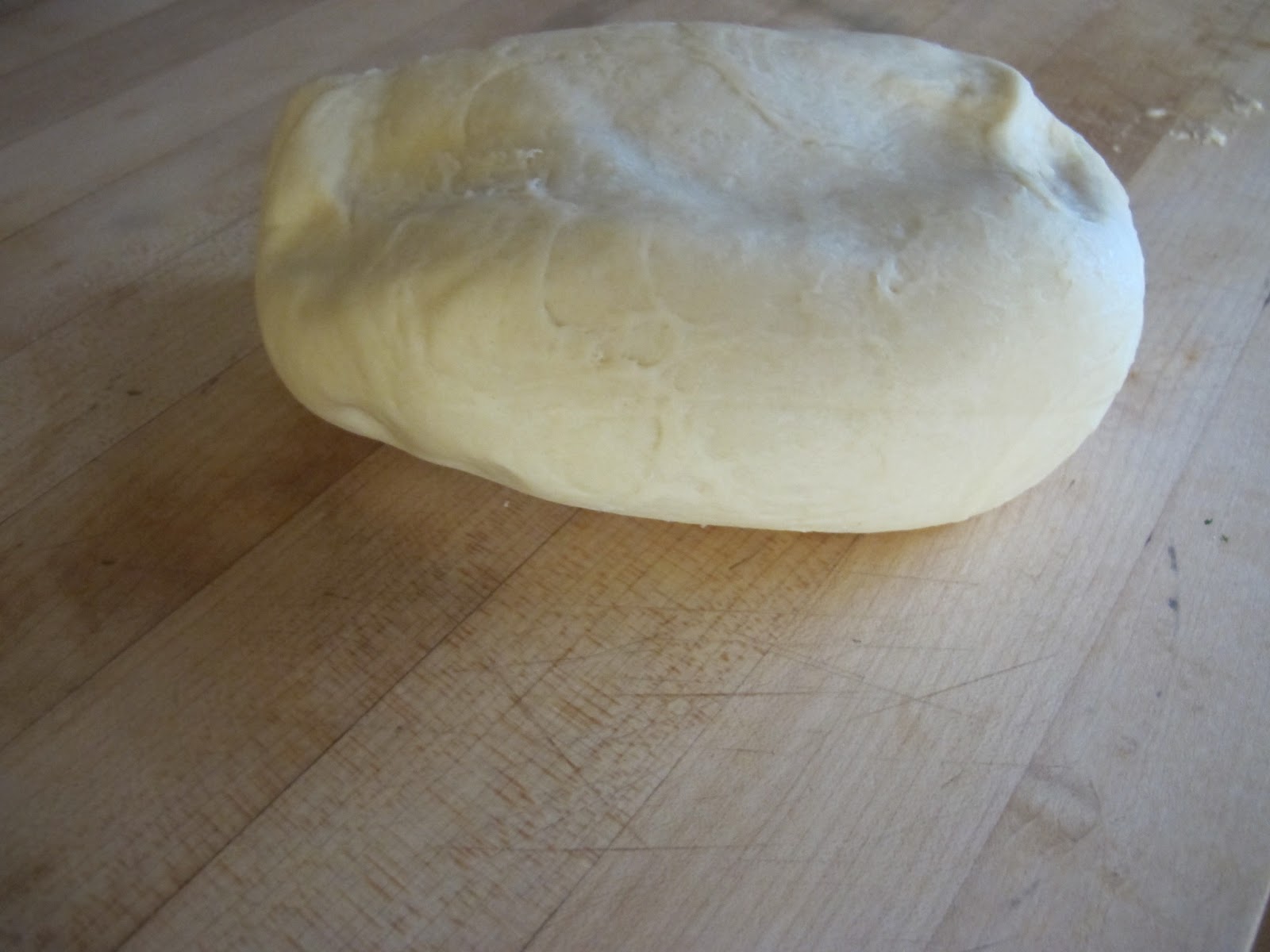
    Let the dough rise and double in size after you’ve first mixed it.

     After the dough’s risen, I punch it down, divide it in half and place each half in a gallon plasic bag.
    It goes in the refrigerator until the next day.  Leave a corner of the bag open to make sure the bag doesn’t burst.  The dough will rise more in the bag (even in the refrigerator.)

    Next morning, when  you’re ready to bake the rolls, grease a 9x12x2 baking pan.

    Take the dough out, punch it down to get the air out,  and firmly pat or roll it out into a rectangular shape using a rolling pin or wine bottle or can of PAM if you’re really desperate.

     It needn’t be perfect, but an approximate 11-inch by 15-inch rectangle is the goal.
    Using your warm hands, spread about a tablespoon of soft butter over the dough.

     Sprinkle on the cinnamon-sugar mixture. (1/4 cup white sugar to 2 teaspoon sugar)

     Using your thumbs, begin to tightly roll up the dough at the long side.  Your goal is a tight roll.

     Once the entire rectangle is rolled, pinch the end of the roll into the rest of the dough so that the entire roll is sealed except for the ends.

     Cut the roll in half, then in half again, repeating until you have 15-16 slices–

    An end might be too small to cut again.

     Places the rolls, cut side down as possible, in the prepared pan, spreading them out as evenly as possible as they’ll expand when they rise.

    These needn’t look perfect; they’ll all rise together and make a beautiful pan of rolls.

    Let the rolls rise to fill the pan–30-60 minutes, depending on how warm your room is.  You can put them in a hot oven for a minute or two to “push” the rise, pull them out,  and then cover them while they sit on the stove.  That’ll save a bit of time.  However you do it, you want the rolls to rise in a warm spot, not a cold one.  Preheat the oven to 375 degrees Fahrenheit and bake the rolls about 15 minutes until just beginning to brown nicely.

    See?

     While the rolls bake, mix up a glaze (see icing recipe below)…and…….

     Drizzle the rolls with a tiny bit of glaze while hot.

    Serve with the Egg-Cheese-Sausage Casserole, of course.

    Cinnamon Rolls–Courtesy early ’70’s Betty Crocker Sweet Roll Dough:
         use half of this dough for 1 pan of cinnamon rolls …  or all of it for two pansor 1/2 for cinnamon rolls (15)
                        and 1/2 for 12-16 dinner rolls, depending on the style and size 

    1/2 cup water warm to the touch (test it on your wrist–you want it warm like a baby’s bottle–any
               warmer and it’ll kill the yeast.)
    2 packages dry yeast or 4 1/2 teaspoons
    1/2 cup just barely warm milk
    1/2 cup white, granulated sugar
    1/2 cup or 8 tablespoons butter, soft
    2 eggs
    1/2 teaspoon salt
    4 1/2-5 cups all-purpose, unbleached flour, divided

    original directions:
    Dissolve yeast in warm water.  Stir in milk, sugar, butter, and eggs.  Mix well.  Beat in 2 1/2 cups flour and beat until smooth.  Mix in enough additional flour to make the dough easy to handle.

    Turn dough out onto a lightly floured board; knead until smooth and elastic, about 5 minutes.  Place in a greased bowl; turn greased side up.  (At this point, dough can be refrigerated 3-4 days.)  Cover; let rise in a warm place until double, about 1 1/2 hours.  (Dough is ready if impression remains when touched.)

    Punch down dough.  Shape dough into desired rolls or coffee cakes.  Cover and let rise until double, about 30 minutes.   Heat oven to 375 degrees F.  Bake as directed.

    This dough could the be made into cinnamon rolls, frosted orange rolls, chocolate cinnamon rolls, butterfly rolls, cheese diamonds,  balloon buns, or various coffee cakes.

    For cinnamon rolls:

    • 1/2 recipe dough
    • 2 tablespoons soft butter
    • 1/4 cup (white granulated) sugar
    • 2 teaspoons cinnamon

    Icing:

    Mix 1 1/2 cups confectioner’s sugar, 1 tablespoon milk and 1/2 teaspoon vanilla together until smooth. 

    Directions:

    1. Roll out dough into rectangle, 15×9 inches, spread with butter.  Mix sugar and cinnamon; sprinkle over rectangle.  Roll up, beginning at wide side.  Pinch edge of dough into roll to seal well.  Stretch roll to make even.
    2. Cut roll into 15 slices.  Place slightly apart in greased baking pan, 13x9x2 inches or in greased muffin cups.  Let rise until double.  Bake 25-30 minutes.  (I find this is too long; I like my rolls less crispy.) While warm, frost rolls with icing.

    For crescent dinner rolls, using the other half of the dough:  Preheat oven to 400 degrees F.  Take the other half of the dough and roll it into a large circle, about 12″ in diameter.  Spread with soft butter.  Cut into 16 wedges.  Roll up, beginning at rounded edge.  Place rolls, with point underneath (or pinch points into body of roll), on greased baking sheet.  Brush with butter.  Bake 15 minutes or until golden.

    eggcheese-sausage casserole
    6-8 servings

    • 2 cups milk
    • 6 eggs
    • 2 teaspoons dry mustard
    • 1 teaspoon salt
    • 6 slices bread, cubed
    • 1 pound bulk pork breakfast sausage cooked and drained
    • 2 cups grated cheddar (or other) cheese   

     Preheat oven to 350 degrees Fahrenheit.  Beat together milk, eggs, mustard, and salt.  Stir in bread, sausage and cheese.  Pour into 2 quart rectangular casserole. Cover and refrigerate overnight if possible.  Remove from refrigerator.   Bake 45 minutes or until firm, golden, and crispy at the edges.  Remove and let sit 10 minutes before cutting and serving.

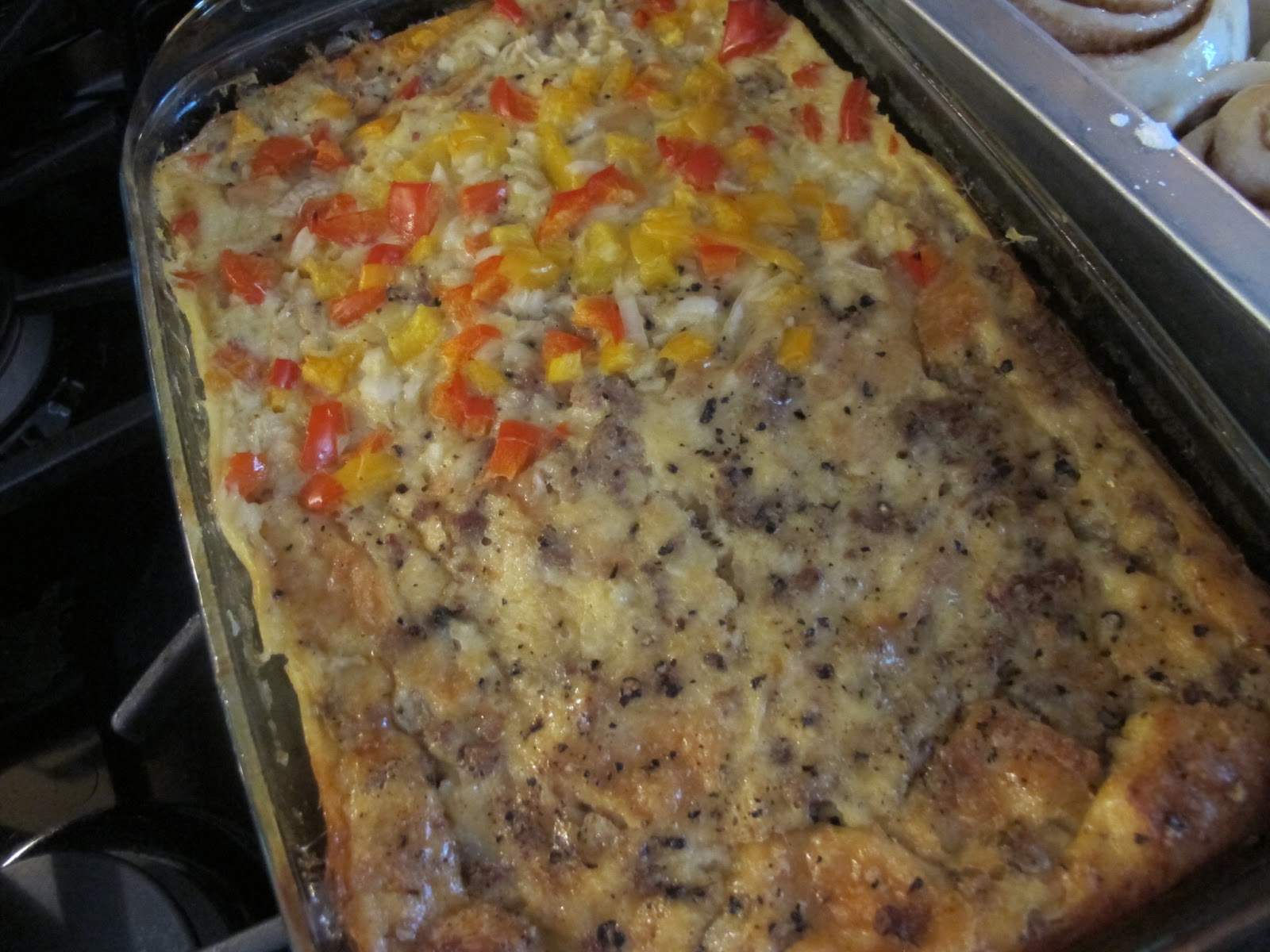
    Variation:  After preparing casserole and before baking, top with 1/4 cup each chopped onions, mushrooms, and red bell peppers.  Sprinkle with fresh ground black pepper.
    You can also use ham or cooked, chopped bacon instead of sausage.  Other options are to stir in 2-3 tablespoons chopped sun-dried tomatoes and a clove or two of chopped garlic that you have lightly sauteed beforehand.  I have also added chopped green chiles once or twice!

    Sing a new song,
    Alyce

    38 Power Foods, Week 26 — Green Peas — Pea Clam Chowder


    (A Repeat Post from June, 2011)

     I love oyster crackers.  Maybe it’s the salt?  The crunch?  The ridges?  The memories?

    Despite days of unpacking (still) and rearranging (forever) and gardening, we’ve still had a few cool evenings and one such night last week, I made, for the first time, one of Dave’s favorite soups.  Now we’ve been married thirty-seven years and why I haven’t made this soup before, I don’t know.  If you’re from the midwest, fish or seafood soups weren’t terribly much part of the cooking pattern when I grew up.  Fish?  Yes.  Fresh out of the thousands of lakes and in the summer. (Though my parents froze quite a bit for great winter fish fries.)  But not fish soup.  Seafood?  A rarity.  You ate it when you went south.  Or east.  Or west.

    Now that we have great fish and seafood available all of the time (especially in St. Paul, I’d add), we have such great options for seafood dishes and I’m finally able to set aside my occasional regional food prejudices and make clam chowder.  I did look at a few recipes and then did it my way.  Naturally you can use fresh clams; I happened to have a couple of cans of clams in the pantry and used those.  In fact, with the exception of the fresh peas (and you can use frozen), this dinner is pretty much out of everyday pantry ingredients. Fresh peas are around only in the late spring in the upper midwest, though Trader Joe’s seems to get them from ??? and often has some in their cold produce section many other times of the year.

    Note:  This is a regular old unthickened chowder and that’s how I like it.  If you’d like thicker chowder, check out this site.

    Peas from late spring Farmer’s Market, St. Paul.  Tender pods:  eat them!

    More available:  Trader Joe’s fresh peas.  Use quickly; they don’t keep long.

     Pea Clam Chowder serves 4

    4 pieces of bacon
    1 large onion, diced
    2 stalks of celery, diced
    1 carrot, diced
    1/2 t sea salt; 1/2 t white pepper
    1 cup chopped fingerling or new potatoes
    1 bottle of clam juice
    Water
    1/4 c fresh peas (or frozen)
    1-2 drops of hot sauce (put bottle on table)
    2 cans drained clams
    2 cups milk
    3/4 c half and half
    1T butter
    1/4 c chopped parsley
    Oyster (or other) cracker

    In a 4 qt stock pot, cook bacon until well-browned and remove to toweling to drain. Chop the bacon and reserve.  Saute onion, celery and carrot in the bacon fat until softenedSeason well with salt and pepper.  Add chopped potatoes and clam juiceAdd enough water to cover all of the vegetables and bring to a boil.  Reduce heat and simmer until potatoes are tender, about 10-15 minutes.  Add peas the last couple of minutes.  Season with hot sauce.  Add milk and half and half.  Stir in drained clams and butter and heat through.  Add fresh parsley and stir in bacon.  Taste and adjust seasonings.  Serve hot with oyster crackers or saltines and let folks add hot sauce as desired.

    Wine:  Chardonnay is my favorite here, but even a nice Viognier or Albarino would work if that’s what you have.

    Music:  “I Got a Pea” 

    Pea shoots and trendrils from the May Farmer’s Market in St. Paul.  I use these in salad or in Pasta Primavera.

     Green Peas–About them:

    Principle Nutrient Value Percentage of RDA
    Energy 81 Kcal 4%
    Carbohydrates 14.45 g 11%
    Protein 5.42 g 10%
    Total Fat 0.40 g 2%
    Cholesterol 0 mg 0%
    Dietary Fiber 5.1 g 13%
    Vitamins
    Folates 65 µg 16%
    Niacin 2.090 mg 13%
    Pantothenic acid 0.104 mg 2%
    Pyridoxine 0.169 mg 13%
    Riboflavin 0.132 mg 10%
    Thiamin 0.266 mg 22%
    Vitamin A 765 IU 25.5%
    Vitamin C 40 mg 67%
    Vitamin E 0.13 mg 1%
    Vitamin K 24.8 µg 21%
    Electrolytes
    Sodium 5 mg
    Potassium 244 mg 5%
    Minerals
    Calcium 25 mg 2.5%
    Copper 0.176 mg 20%
    Iron 1.47 mg 18%
    Magnesium 33 mg 8%
    Manganese 0.410 mg 18%
    Selenium 1.8 µg 3%
    Zinc 1.24 mg 11%
    Phyto-nutrients
    Carotene-ß 449 µg
    Crypto-xanthin-ß 0 µg
    Lutein-zeaxanthin 2477 µg

    (Source: USDA National Nutrient data base)

    ^^^^^^^^^^^^^^^
    I blog with a great group of writers every Friday where we cook our way through the list of foods from Whole Living Magazine’s Power Foods:  150 Delicious Recipes with the 38 Healthiest Ingredients:    Read more about tasty peas at these sites:

    Ansh – SpiceRoots.com  
    Minnie Gupta from TheLady8Home.com

    Sarah – Everything in the Kitchen Sink

     Sing a new song,
    Alyce