I do love soup. Ask anyone who knows me. I’m never happier than when a big cauldron is bubbling away merrily on a front (or back) burner. I like fast or slow soups. Vegan, vegetarian, or meaty stews. From scratch, on purpose, or fly-by-the-seat-of-the-pants clean out the frig pots.
I love soup for Dave and me, for dinners with friends, or for parties. Last week, my friend Sue was coming for supper on Friday night. I didn’t want a complicated (IS THIS or this DONE YET?) meal. Soup was perfect; I’d have the entire evening to spend with her and Dave. I knew I had some ham from Grandma and Grandpa, as well as two huge chicken breasts leftover from a casserole I’d made Wednesday. At the store, a couple of beef shank bone slices with quite of bit of meat on them sealed the deal. I’d make minestrone. While there’s really no need to use three different kinds of meat/poultry, I did it because I had it on hand; I bought the beef to make the stock. If you, for instance, have some pork roast or Italian sausage leftover, cut it up and throw it in. If you only have a ham hock, forge ahead–using the hock where I’ve used the beef shank slices.

What makes minestrone minestrone?
It’s an Italian vegetable soup (minestra is SOUP in Italian) that often has dried beans or rice or pasta in it. It’s full of fresh and/or dried herbs and can be a bit spicy, if you’d like it that way. There are no hard and fast rules about specific vegetables, meats, etc.; Si piace. (Do as you please!) It’s all dependent on the season and what’s available. Many minestrones, as Americans know them, include tomatoes, zucchini, and fresh spinach. One very definite thing is that any minestrone should be a fairly substantial soup with all of the vegetables intact–lots of different textures, though by the time it’s cooked, the vegetables all appear to taste of one another. We don’t blend or puree minestrone, though you might mash a few of the the beans to give the soup a bit more body if you like.
Minestrone is often made with EITHER pasta, beans, or rice–depending on the part of the country (Italy) where it’s made , i.e. what’s available. As I make it in Minnesota, I put in whatever I have and am glad of it. The things I personally can’t leave out are the dried beans, herbs, and the Parmesan. Otherwise it looks (and tastes) like Grandma’s vegetable soup.
If, I said IF, this truly were MINNESOTASTRONE, I’d have made it with wild rice because that’s what we have here. (Right after tater tot hot dish, walleye, juicy lucies and beer.) That’s right. And maybe I’ll try it next time. Why not?
One odd American admission: I really like Minestrone with baguette and just a little butter. The butter melts a tad when you dunk your bread in the soup (you really must dunk) and is truly luscious. Don’t tell the Italians, please.

For detailed and accurate information on minestrone (and all Italian food), read Marcella Hazan. You can depend on her much, much more than what just happens to come up on the internet. (Sometimes there really is no such thing as free information.) Try Essentials of Italian Cooking by Marcella Hazan; New York: Knopf, 2001. This volume is a combination of her two books, THE CLASSIC ITALIAN COOKBOOK and MORE CLASSIC ITALIAN COOKING.
Buon appetito! Make your own minestrone! Just for a pattern, here’s how I did it this time….
alyce‘s minnesotastrone-big pot full makes about 10 quarts
(Ingredients are in bold print.)
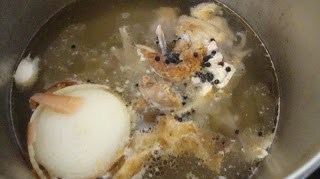
1. Place two-three beef shank bone slices (or one big beef soup bone) in a 12-quart stock pan. Fill pot half full of water. Add a cup of dried white beans, an onion cut in half, two stalks celery, two carrots, two garlic cloves, 1/2 cup chopped parsley (or a small, tied bundle of parsley), 1/2 teaspoon each kosher salt and black pepper, and a good pinch of crushed red pepper. Bring to a boil, lower heat to a good simmer, cover, and let cook until the meat on the bones is tender--an hour to an hour and a half. Beans won’t be done yet, most likely.
 |
| Here’s a bundle of parsley + thyme. Don’t waste fresh herbs. You can use stems for soup and pull the bundle out at the end. |
2. Remove the shank bones and let the meat cool a few minutes. Remove the large pieces of vegetables and either discard them or do as I do: mince or blend them and return them to the pot. Chop the cooled meat and add to the broth. (Give the bones to the dogs if your dogs are able to have them.)
 |
| Just say, “Bones?” |
3. Add 1/2 cup chopped smoked ham (or half a ham hock or a smoked pork chop), and 2-3 cups pulled or shredded cooked chicken. Stir in 2 teaspoons each dried basil and oregano.
4. Add 1 chopped onion, 3 each chopped celery stalks and large carrots, 1 cup trimmed and chopped fresh green beans, 1 cup chopped cabbage, a 28-ounce can of chopped tomatoes, 2 tablespoons tomato paste, 1 cup white wine, 5 cups beef or chicken stock, and a rind of Parmesan (if you have one). Add enough water to fill the pot 3/4 full and bring to a boil.
5. Lower heat to a simmer. Taste and adjust seasonings if needed. Let simmer another 1-2 hours until everything (including dried beans) is tender. During last ten minutes or so, add 1/2 cup each tiny pasta (I used ditalini–tiny tubular pasta), frozen peas, frozen corn, fresh sliced spinach, and chopped fresh zucchini (Potatoes are optional, but if you’d like some or have extra, add one chopped potato during last 20 minutes of cooking.) If you’ve used a ham hock or a smoked pork chop, remove from the pot, let cool, chop, and return meat to soup. Taste and adjust seasonings.
Before you add lots of salt, try a couple of shakes of Tabasco. It won’t heat up the broth terribly (if you really only do 2-3 shakes), but it may give the soup some missing body. If the soup is too thick, add a bit more water or broth and cook a little while longer. It shouldn’t be like stew (it should be soupy–quite loose with lots of broth) unless you like minestrone stew–in which case that’s great.
Set the table; pour the wine now while the tiny pasta cooks.
6. Serve hot in warm bowls with grated Parmesan and/or finely shredded fresh basil. Make sure there’s a black pepper grinder at the table, as well as lot of sliced baguette (or garlic bread) to sop up the broth. An inexpensive Chianti is all you need to drink.
 |
| Warmed oven-safe bowls |
Ribollita (leftover minestrone with bread to stretch it) was one of the first dishes I ever blogged. Check out my early effort here.
If you’d like an Italian vegetable soup where the vegetables all maintain their own bright flavors, try this recipe based on a Lydia Bastianich soup–Zuppa di Verdure.

^^^^^^^^^^^^^^^^^^^
On my Dinner Place (Cooking for One) blog this week:
One-Pan Lemon Chicken with Mushrooms and Shallots

two-dog kitchen and around the ‘hood
My world begins to fall together again this week. Church choir rehearsals begin tomorrow. Worship planning starts. Wednesday women’s breakfast is on. Next Sunday is the Baptism of Jesus…though we have a guest preacher and I don’t think that’s the topic. In other words, Epiphany came and went (I know–some churches have Epiphany for weeks.) and we had friends over for cards and stew on Sunday night –one last Christmas bang-up with all the lights on, the carols blaring, and the holly hanging. Yesterday found me 🙁 de-Christmasing. Why is it the house looks so empty without a tree? Why does it make SO MUCH SENSE to have a tree in our house? I’m thinking of getting one that truly grows indoors. In the meantime, my basil is nearly a tree in the south window. It’ll have to do.
I have to make do without my daughter home…she’s back to seminary. And when I next see her, she’ll be ready to be ordained. It’s a big year.

Yesterday I visited a friend whose tree was still up and decorated. She said, “I leave it up until the magic is gone.” Definitely.
Sing a new song,
Alyce